For most Los Angeles homes with thin, compressed or damaged attic insulation, yes, attic insulation is worth it. It slows heat leaving the house on cold winter nights and heat pouring in on summer afternoons, so the furnace and the air conditioner run less. The size of the payoff depends on what is in your attic now, and an attic that already meets the recommended level gains little from more.
Is attic insulation worth it in Los Angeles?
The U.S. Department of Energy's Guide to Home Insulation says that, on average, you can save up to 20% on heating and cooling costs, or up to 10% on total energy costs, by adding insulation to attics, floors, crawl spaces and accessible basement rim joists and by reducing air leaks around the house. Your own result depends on your starting point.
ENERGY STAR puts the effect in plain terms: low attic insulation and air leaks make your air conditioning and heating systems work harder, which wastes energy and makes the house uncomfortable in both summer and winter.
In Los Angeles the case has two halves. In winter, warm air from your heater rises into the attic and leaks out through the ceiling, so the furnace runs longer to hold the temperature. In summer the attic bakes. The California Energy Commission notes that on a hot day a typical vented attic is hotter than the air outside, and that in homes with little or no attic insulation, that temperature difference can mean significant heat gain or loss through the ceiling. One layer in the right place helps in both seasons.
Want a straight answer on your system?Most repairs can be estimated free over the phone. Open 24 hours Sunday to Thursday, Friday 9 AM to 3 PM.
Call (310) 469-1979What R-value does a Los Angeles attic need?
R-value measures how well insulation resists heat flow, and a higher number means better performance. ENERGY STAR's recommendations for existing wood-framed homes, based on the 2021 International Energy Conservation Code, list R49 for an uninsulated attic in zone 3, and R38 if you already have 3 to 4 inches of insulation. Los Angeles County falls in that zone 3 on the federal climate map.
California has its own rules too. The state's Energy Code divides California into sixteen climate zones, and the Los Angeles area spans several of them. For zone 9, which covers much of the Los Angeles basin and the San Fernando Valley, the California Energy Commission's compliance manual says that when attic insulation is added or replaced, the attic floor over conditioned space is insulated to R-49. If the existing insulation is below R-19, the requirements also include sealing the ceiling and handling recessed can lights, and attic ventilation has to meet code. Your address may sit in a different zone, so the Energy Commission offers an address-based climate zone tool, and a local building department has the final word on permits.
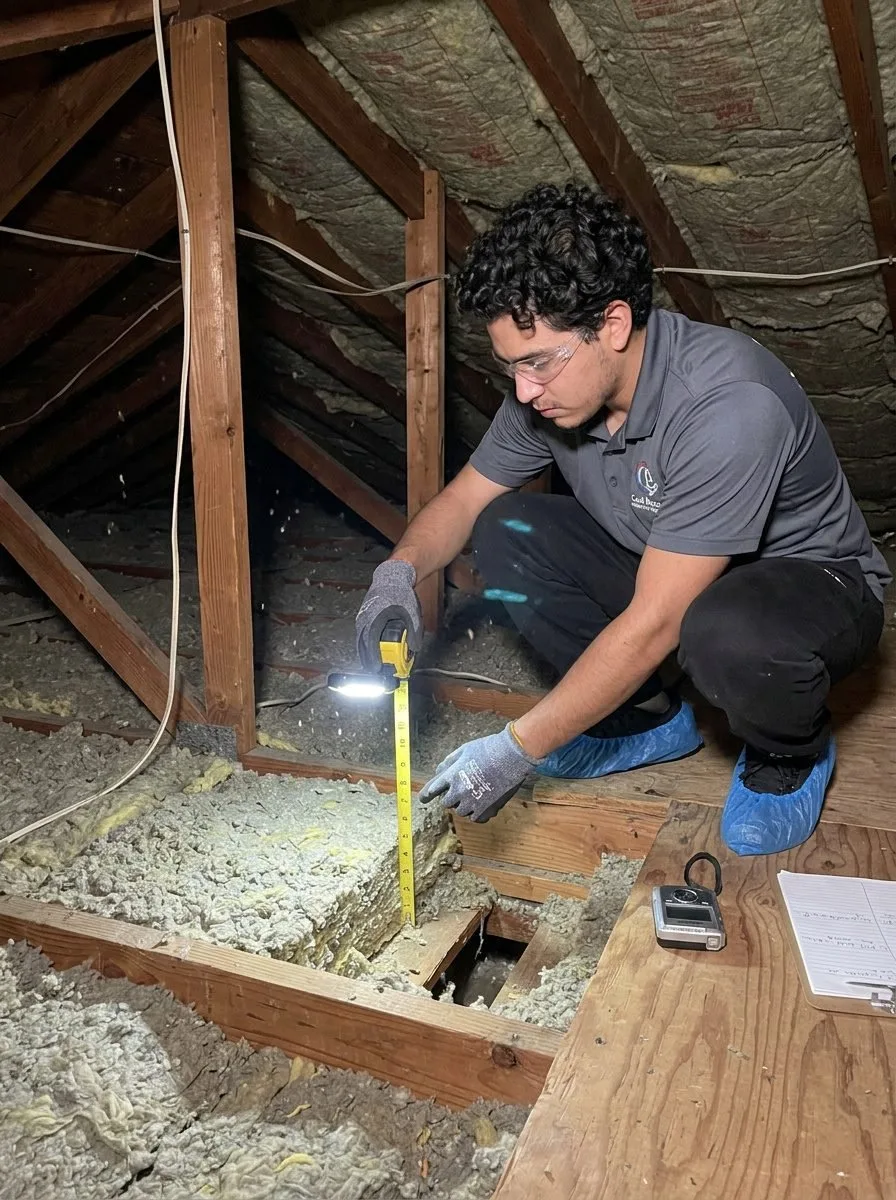
You can estimate what you have. ENERGY STAR says most common insulation types, including fiberglass, cellulose and mineral wool, have an R-value of about 3 to 3.5 per inch, so the depth in inches times 3 gives a rough figure. Ten inches is roughly R30, which is below both targets above.
How do I know if my attic is under-insulated?
Look first, and measure second.
- Open the hatch with a flashlight. ENERGY STAR says that if the insulation is at or below the level of the floor joists, you probably need to add more.
- Measure the depth with a ruler and multiply by 3 for a rough R-value.
- Notice whether rooms under the attic run hotter or colder than the rest of the house.
- Check for insulation that has matted down, shifted away from the edges, or has bare patches around the hatch, ducts and light fixtures.
Walk only on the joists, since a step on the ceiling drywall between them can go through. If the attic is hard to reach, a technician can do this check for you.
Blown-in or batt insulation: which is better for an LA attic?
Both can work. The DOE describes blanket insulation, in batts and rolls, as perhaps the most common type used in American homes, and loose fill as adaptable insulation that can conform to any space without disturbing structures or finishes. ENERGY STAR lists loose-fill and blown-in insulation as well suited to unfinished attic floors and hard-to-reach places, and says most contractors use blown-in loose fill for attic floors because it is quick and easy to install with the right equipment. Typical materials are fiberglass or cellulose.
Because loose fill conforms to any space, it suits an attic floor full of joists, wiring and odd corners, and it is what we install. If batts or rolls are used instead, ENERGY STAR advises unfaced material, with no foil or paper backing, so moisture does not get trapped.
Why does air sealing come before insulation?
Warm house air that leaks into the attic around light fixtures, pipe and wire openings, the flue and the hatch bypasses the insulation, and sealing those gaps first lets the insulation do its job.
ENERGY STAR is direct about this. It says contractors should seal air leaks in the attic floor before adding insulation, and it tells homeowners to confirm the contractor will do so: if they do not agree to seal before insulating, call another contractor. It also recommends covers for recessed lights, a sealed plumbing vent chase, and a weather stripped, insulated hatch. Insulation baffles (rafter vents) should be part of the estimate, so that soffit vents stay clear and the attic keeps its airflow.
One safety note. If a gas furnace or water heater sits in the attic, ENERGY STAR says a professional HVAC contractor should do combustion safety testing after air sealing. If the attic work turns up a problem with the heater itself, see our heating repair page.
When should old attic insulation be removed?
Usually it does not have to be. ENERGY STAR says that unless old insulation is wet, moldy, smelly or contains animal waste, contractors can add new insulation on top of it. Removal is for insulation that has failed.
- Wet or damp insulation, which points to a roof leak. Fix the leak first.
- Moldy or rotted rafters or joists, which point to a moisture problem.
- Droppings, nesting material or a rodent smell. ENERGY STAR asks contractors to tell you if they see signs of birds, mice or squirrels living in the attic.
- Bathroom or kitchen vents that end in the attic, or little to no attic ventilation. ENERGY STAR lists these as problems to correct first.
Rodents and moisture are the two things to rule out before any new insulation goes in. Damp insulation points to a leak that has to be found, and animal waste means the old material needs to come out. Fresh insulation laid over either one hides the problem and leaves the cause in place.
One more thing to know about older homes. ENERGY STAR warns that some attics have vermiculite insulation, which may contain asbestos, and says not to disturb it until it has been tested by an approved lab. If you see it, leave it alone and tell the contractor.
What does a proper attic insulation job include?
Our attic insulation service follows the order that makes the result last:
- Removal of old or damaged insulation, where the inspection shows it needs to come out.
- Air sealing of the gaps and penetrations in the attic floor.
- Blown-in insulation brought up to the target depth and R-value, with baffles keeping the vents clear.
- An insulated and weather stripped attic hatch.
ENERGY STAR says the contractor should give you documentation at the end showing how much insulation was added and the new R-value. Ask for it. Our visit comes with a written quote before work starts, and we are licensed under CSLB #1154105.
Insulation is one piece of the whole system. Our HVAC maintenance checklist for Los Angeles homeowners shows where it fits, and our guide to duct cleaning signs covers another part of the system worth checking this winter.
Common questions
Does attic insulation help in a mild climate like Los Angeles?
Attic insulation helps in Los Angeles. Heat moves through the ceiling in both directions, so insulation helps on cold nights and hot afternoons.
Can new insulation go over the old?
New insulation can often go over the old, unless the old insulation is wet, moldy, smelly or contains animal waste. Air sealing should still happen first.
Is blown-in or batt insulation better?
Blown-in is the usual choice for attic floors because it fills gaps and installs quickly. Batts work, but they need to be cut and fitted carefully, and unfaced batts are the right type for an attic floor.
How do I know how much insulation I have?
Measure the depth in inches and multiply by 3 for a rough R-value. If the insulation sits at or below the tops of the floor joists, you probably need more.
Is it safe to do this myself?
Looking in your attic and measuring the insulation yourself is fine. Walk only on joists, and leave gray, pebble-like vermiculite alone, since it may contain asbestos. Air sealing and removal are better left to a licensed contractor.
Get your attic looked at this winter
Cool Breeze LA serves Los Angeles County and the San Fernando Valley with same day service and a written quote before work starts, and we are licensed under CSLB #1154105. We are open 24 hours Sunday to Thursday and Friday from 9 AM to 3 PM, and closed Saturday. Call (310) 469-1979 or schedule online.